
Blog
The Pee App
Sep
There are apps for everything. Counting steps, tracking sleep, monitoring heart rate, telling us where we parked, identifying shrubs you might want to pee behind, and some that prompt us to breathe, which I thought the body had pretty much handled for thousands of years on its own, until Silicon Valley intervened. But no one has developed an app for women of a certain age that tells them where they can pee when they’re out.
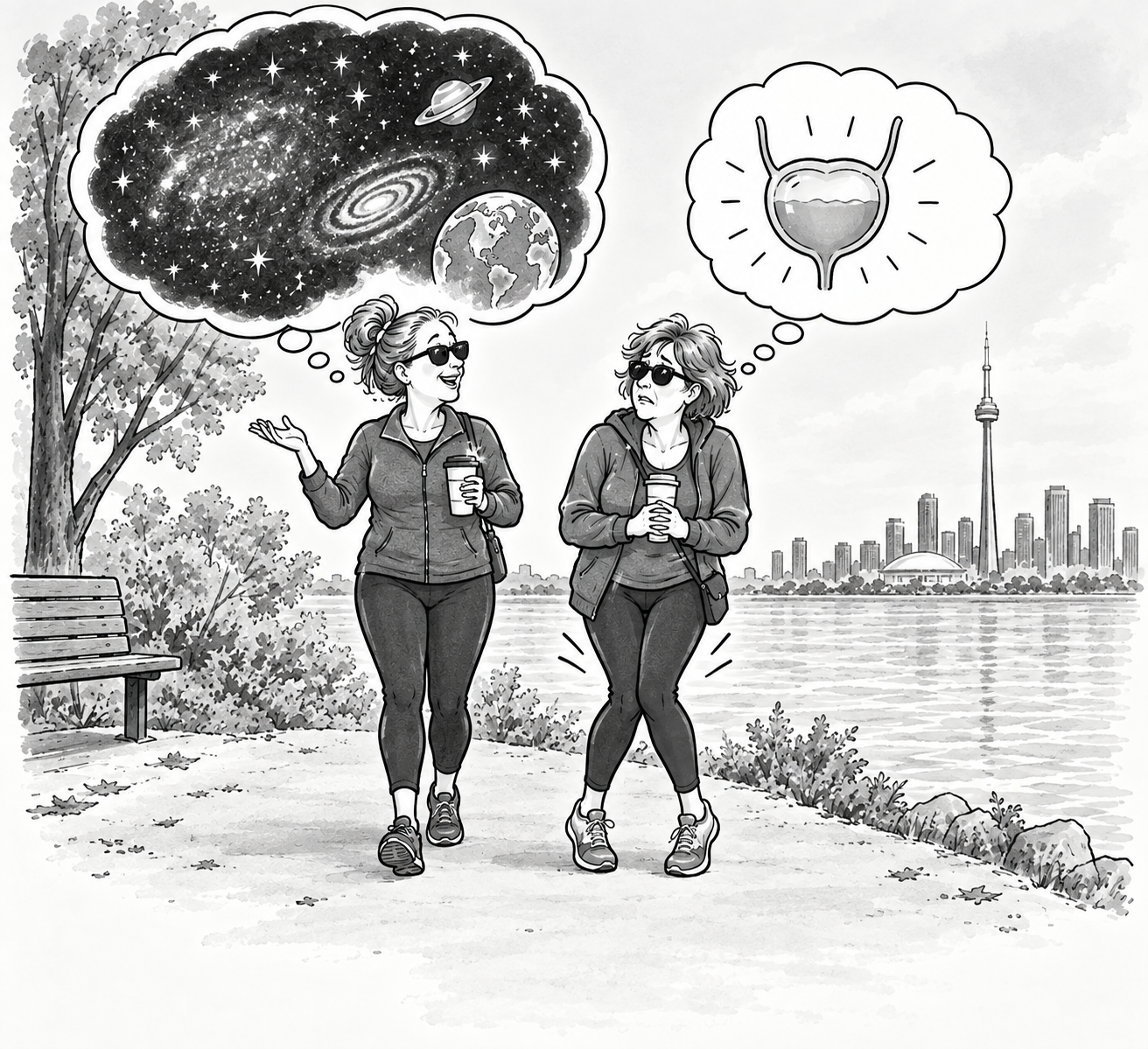
Every Sunday, I take what I call my Sacred Sunday Walk with my soul sister. We walk, drink tea or coffee and solve the world’s problems through the lens of the Universe. We’re actually pretty good at it. We’ve discovered most global problems are surprisingly solvable when handled with common sense, compassion, and a decent latte. Wars? We have thoughts. Democracy? Easily an hour. The meaning of life? It depends on the weather, but existential conversations feed our souls as much as lattes feed our bladders.
But approximately forty-five minutes into the walk, all philosophical discussion comes to an abrupt halt because one of us has to pee. Suddenly the Universe is no longer expansive. It is about the size of a bladder, and it’s full. This is where I believe technology has spectacularly failed mature women, especially since apps can find a stranger willing to drive across the city, pick you up, and drop you off at another stranger’s house, where you will sleep in their bed. Think about that.
Technology can coordinate strangers, vehicles, houses, meals, money, and international travel, yet apparently locating a clean, functioning toilet along a walking route in a major city remains beyond the outer limits of human innovation. We can land on Mars and set up a 711 on the moon, but apparently where I can pee within the next seven minutes remains one of civilization’s great unanswered questions. And while everyone worries that A.I. may destroy humanity, maybe we could put it to work helping humanity empty its bladder first.
For some time now, bathrooms have become contentious. Some businesses understandably reserve them for customers. Others don’t, or claim they don’t even have public facilities. Some parks have washrooms, but only if you happen to visit during the mysterious seventeen-minute window when they’re unlocked. Others have seasonal facilities, because apparently bladders migrate south for the winter.
But things changed over the decades. Traditional public facilities started to disappear, including department stores, while other establishments, concerned about vandalism, drug use, cleaning liability, and staff safety, closed their washrooms. The unhoused and untreated mental health and addiction problems became increasingly visible in washrooms, so security codes and customer-only policies proliferated, and municipalities left washroom provision to private businesses. Consequently, we created a modern quandary. Cities promote walking and active aging, but don’t provide the facilities to support them. Perhaps city planning needs more women and an additional box at the bottom of their forms to read “Where to pee?” before approving yet another grand vision for walkability, active aging, and dynamic public spaces. And somebody should be required to answer it. Because if the answer is “Tim Hortons,” we don’t have a public-realm strategy. We have outsourced the human bladder to the private sector.
In the 60s and 70s, washroom access was integrated naturally into public life: department stores, diners, gas stations, hotels, libraries, and train and bus stations. Of course you needed to pay your dime in some cases, but it was still available. What changed was that we redesigned the city around it. Today, the city could staff facilities in higher-risk locations with attendants or nearby staff, regular cleaning, and rapid maintenance. Higher-use locations may need purpose-built public toilets rather than expecting a librarian or café owner to provide unpaid security. It would also boost tourism, so visitors wouldn’t have to worry about the same thing because it’s been addressed.
Taxpayers already pay for libraries, community centres, rec facilities, government buildings, and other publicly funded spaces with washrooms that could form a citywide public washroom network during operating hours. We don’t need to build our way out of this problem; we need to unlock a few doors. There is something exquisitely absurd about standing outside a taxpayer-funded building, desperately needing to pee, while being told the taxpayer-funded washroom inside isn’t for taxpayers.
What women our age need is not another mindfulness app. Trust me, when your bladder is flowing into your eyelids, you are extremely present. We need PeeNav. No matter which city you travel to, you download this app and relax. Grab a latte, grab a juice, or grab one of those outrageously large water bottles because you’re covered.
You enter your walking route, and PeeNav identifies every available washroom along the way: in cafés where you ultimately buy another beverage as you release what you’re holding, libraries, community centres, parks, hotels, and businesses participating in some civilized bladder-alliance program. All government offices and institutions should naturally be part of the app. There could even be ratings. Five Flushes: Immaculate. Warm water. Hooks for your handbag. Civilization thrives. Four Flushes: Clean, accessible, no interrogation. Three Flushes: You’ll live. Two Flushes: Don’t touch anything. One Flush: Reconsider the bush outside.
Unlike other navigation apps, PeeNav would understand urgency. No cheerful little voice announcing, “You have arrived at your destination,” only to discover the washroom requires a key held by a seventeen-year-old named Kevin who has disappeared on his break. There should be an emergency setting. At Code Yellow, the map eliminates all establishments that require purchases, passwords, keys, or long explanations. Then comes Code Orange: walking speed increases dramatically, and conversation stops. Finally, Code Red: dignity is now negotiable. Show me everything.
The app could also design walking routes around nearby facilities. This is the ludicrousness: cities like Toronto spend enormous amounts of money encouraging people to walk, cycle, age actively, and use public space, yet the biological consequences of drinking water while doing so apparently come as a surprise. How is something so obvious invisible?
Public washrooms aren’t glamorous infrastructure. Nobody cuts a ribbon in front of a toilet and poses for photographs. Perhaps that’s the problem. But they determine who can comfortably participate in public life: older adults, pregnant women, parents with children, people taking certain medications, people with disabilities, and, frankly, anyone with kidneys. A city isn’t truly walkable because somebody painted footprints on a planning document. It’s walkable when you can actually walk through it. The measure of a truly civilized city isn’t how many grand projects it builds but where a 65-year-old woman can drink a coffee and go for a two-hour walk without having to develop the bladder control of a Navy SEAL.
So while my soul sister and I continue our Sacred Sundays, solving geopolitics, municipal dysfunction, human consciousness, and occasionally what we’re having for lunch, I have one modest request for the great innovators of our age: Forget another dating app. Forget an app that tells me about the constellations or how much water to drink. That’ll only make matters worse. Give me an app that tells me where I can pee.
Apparently, we can solve the world’s problems on a Sunday morning. We just can’t solve them too far from a bathroom.